10/13/2013

Halicarnassus, memories of a sunny day

It's october, winter is coming. The days we had sun bath under the Aegean sun are over.
But memories are still fresh! So what do I remember? Firstly, I remember the song about Bodrum, secondly Bodrum Castle or  Bodrum Museum of Underwater Archaeology.

The castle was  built by The Knights of Saint John between the years 1406 and 1522

Arms of Knights
 After conquest of Rhodes, the castle was captured by Ottomans.

Marks from Ottomans


As the irony of fate the castle was built with rocks of one of the Seven Wonders of the ancient World, The Mausoleum of Halicarnasus.
I said irony because, there is almost nothing left from Mausoleum of Halicarnasus. But, this is another subject of another writing.
These days, castle having calm days compared to Ottoman & The Knights of Saint John times. It is now served as a museum.
Admission fee is TL 20.
The castle is huge, it is possible to spend like 4-5 hours to visit entire castle. This "must see museum" is one of the best underwater archaelogy museum of the world.

Amphoras

An amphora is a double handed clay jar. In the ancient times, amphoras were used for commercial purposes. They were used to store wine, olive oil and dry food. At first glance, all amphoras look like same,  double handed  terra cotta jars. For instance pointed amphoras were used for trading. Because they took small place. Roman amphoras have rims with a long neck. Knidion amphoras have cone shaped handles.


Bodrum Museum has a huge amphora collection. Because most of those amphoras were found in water excavations.


The Glass Hall

In the Glass Hall you can find glass artifacts dating from 14th century (BC) to 11th century (AD)


The Snake Tower
At the entrance of tower you'll see a snake. Snake is symbol of medicine. So the tower was used as medical room.
But today it is home of amphoras all around the world.


Carian Princess
 
Carian Princess, her name is Ada and known as step mother of Alexander The Great. She was found in an excavation in Bodrum. The foundings were sent to Manchester University for facial reconstruction. So you can see what looks like Princess Ada. Between the years 344-341 BC, she became Persian Satrap and ruled Caria.
At Carian Princess hall, it is not allowed to take pictures.


 Uluburun Shipwreck

The Uluburun shipwreck is the oldest wracked of the world.


Real size replica
The ship was 15 m long and it could carry 20 tons of cargo. The ship was carrying
  • amber
  • gold
  • resin
  • weapons
  • clay lamps
  • pots
  • Golden seal of Nefertiti


The Dungeon


10/12/2013

Oh là là! L'art Contemporain

La semaine derniére, Je suis allée Treizième Biennale D'İstanbul en tant que amateur d'art. Mais l'amour n'est pas assez jamais. Mon amour à l'art n'est pas assez à comprendre que l'artistes ont essayé vouloir dire. Par exemple,  regarde ci-dessous l'image. Que voyez-vous? Je vois  les pots. Mais il dit; les plantes peuvent communiquer.
Donc, si vous comprenez "L'art Contemporain" obtenir un guider


Maman, suis-je barbaric? Le concept de le Biennale D'İstanbul. Donc, Qu'est-ce que ça veut dire "barbaric"? Maman, suis-je barbaric est le nom d'un livre de poésie. Le nom de l'écrivain est Lale Müldür.


Wang Qıngsons


Les Tulipes parlons
 
Le nom de la pièce est 13 Essential Rules for Understanding the World. C'est une vidéo. Dans la vidéo,  les tulipes racontent les régles a comprendre le monde.

Basim Magdy


L'ombres


Mere Phantoms

Mere Phantoms

 Vous connaissez Karaköy? Karaköy est le quartier D'İstanbul. Dans l'image, vous voyez Karaköy et bleue lignes décrivent les routes alternative. L'Artiste attire l'attention sur problème des embouteillages


Maider Lopez-Traffic Jam
Il y a tellement des piéces dans l'exposition. Je recommande a visiter l'exposition. Cette année, C'est gratuite.


9/04/2013

Victory, wisdom and wealth, Civilization under the ground

Victory, wisdom and wealth, Civilization under the ground
I was 10 or a little bit older when I first visited Ephesus; I was sick and had a fever. I can only remember the long marble road and Library of Celcus. But I knew that; my archaeology passion would bring me this magnificent ancient city again. After almost 22 years later, I was in Ephesus again, I have waited more than I imagined.
Great Theater


Great Theater
 
When you first enter the city Great Theater will welcome you.  With 25.000 person capacity Great Theater is the largest in Anatolia. It was first constructed in the Hellenistic Period and took its present shape in Roman Period. It was proven that the theater was used as a gladiator arena.
Tetragonos Agora

Reminings of Agora
After Great Theater you’ll see Tetragonos Agora (commercial Agora) Tetragonos Agora will lead you to beautiful South Gate Agora, throughout the centuries official notices and legal amendments about commercial agora were hanged on walls of South Gate. Gate was built by Mazeus & Mithridates and was demolished with an earthquake in 13th century.


South Gate

Library of Celcus
Rest a little bit under the shadow of South Gate, take pictures and admire the skilled masters Mazeus & Mithridates. When turn your back to Tetragonos Agora, on the right side, you’ll see Library of Celcus.
Front


Ceiling


 Library was built in the memory of Tiberius İulius Celsus Polemaeanu by his son Gaius Iulius Aquila. Grave of İulius Celsus Polemaeanu was beneath under floor of Library. At the entrance you’ll be welcomed by 4 ladies, wisdom, knowledge, fate, virtue.
Temple of Hadrian
Temple of Hadrian
Hadrian Himself
After Library of Celcus, you’ll pass by “love house”, on Curetes Street you’ll see “Temple of Hadrian”. According to an architectural tablet this monument is bringing honor to Hadrian. Reliefs on the door, picture the foundation legend of Ephesus.
Traianus Fountain
Traianus Fountain
Fountain was built in honor of Emperor Traianus and Ephesian Artemis. In the middle there is a statue which belongs Emperor Traianus. Under the feet of statue there is a sphere which represents earth.
Heracles Gate
Heracles
At the end of Curetes Street you’ll see two pillars. Both pillars were decorated with representations of Heracles. That’s why it’s called Heracles Gate.
Nike
Nike
Nike, goddess of victory is one of symbolic icons of Ephesus. In relief of Nike, she holds a wreath made from laurel leaves. This wreath made from laurel leaves represents victory.
Processional Way
Processional Way
Every year in ancient era, so-called Artemisia or Ephesia festivals were organized in honor of Artemisia, protected goddess of Ephesus. As part of those festivals; sports and music contents were organized but cortege was centre of attention.
Curetes Street

Street

Curetes Street is one of main streets of Ephesus. Street is between The Hercules Gate and Celsus Library. There were fountains, monuments, statues and shops on the sides of the street.
Terrace Houses or Houses of Rich
Terrace houses 2 can be described as a big island called as insula (a kind of apartment building in ancient Rome that provided housing for all but the elite, source-Wikipedia).
Those rich houses had the highest comfort. Walls were covered with frescos and floors were covered with mosaics. Every house had baths and heating system.

Interior Walls


Lion

Indoor


interior walls

Indoor

Indoor

Granolithic Floor

Fish on the wall

Granolithic Floor


Indoor


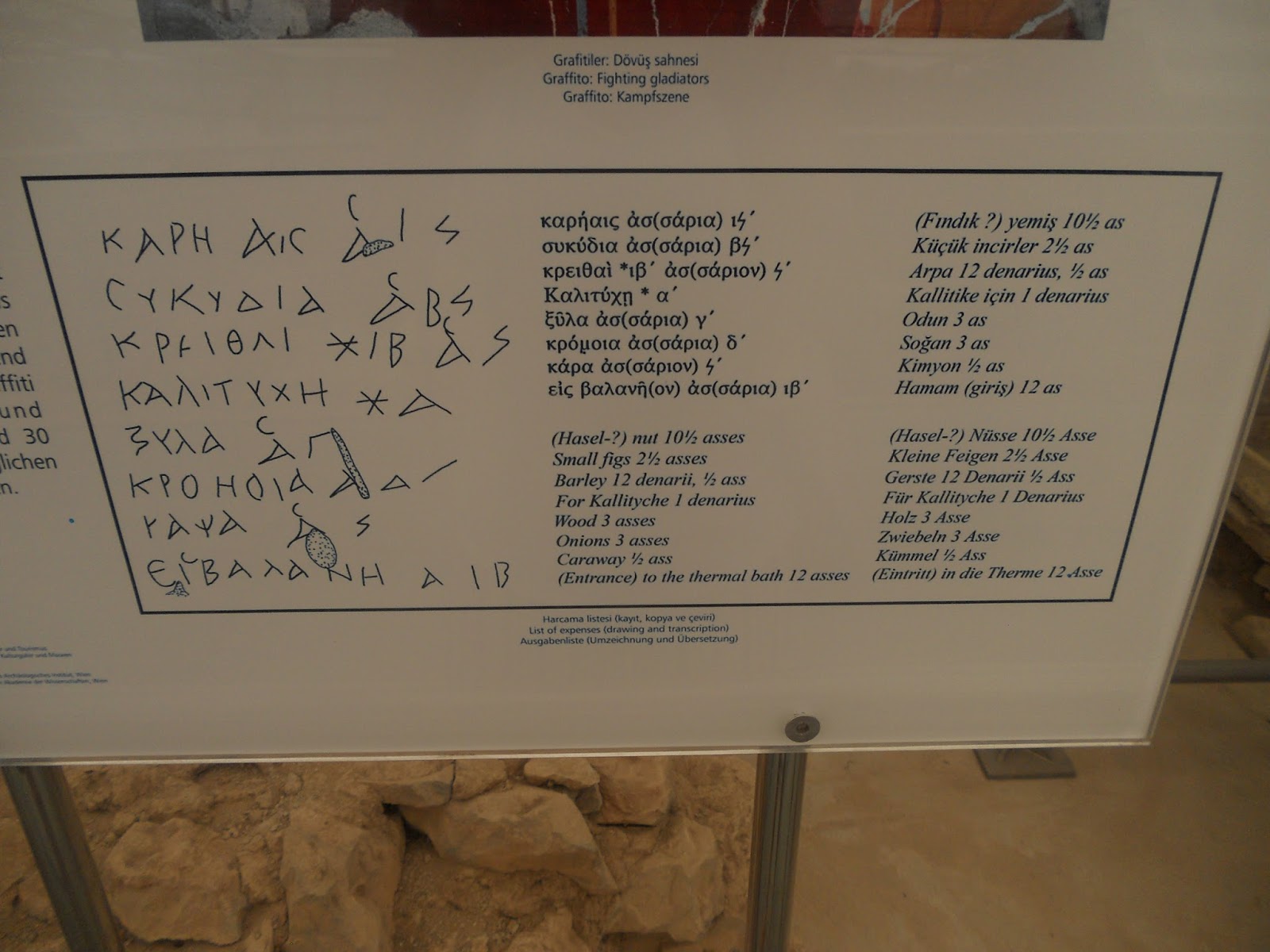
Graffiti in Terrace House 2
Drawings and writings were scratched on frescos. Those are giving information about daily life. On the drawings, generally, gladiators and animals were pictured. Writings are generally about love and poetry.


Gladiators


Graffiti

     I should remind you, it’s going to be a long journey.  So bring water and snack food. If you feel tired you can relax under the trees of Ephesus. Exit of the city you’ll see cafes. If you feel hungry or thirsty you can try those cafes.
If you want to buy something for your beloved ones there are also souvenir shops around cafes. But I suggest you to try museum shop.


Celcus Library and South Gate


Ar View


8/14/2013

Sou Mela


Hello to all!


Yard
 Before writing about Pergamon and Ephesus, I had decided to write about my Trabzon trip. Due to reasons beyond my control, I visited only Sümela Monastery and Atatürk’s Villa. I was planning to go to Uzungöl Plateau and stay one night there but you know what they say “If You Want to Make God Laugh, Tell Him Your Plans.”
According an oft-told story among Black Sea Greeks, two monks from Greece had the same dream, in their dream they saw Saint Luke’s Panagia in Sümela, thereupon those two monks came to Trabzon by sea, totally unaware of each other’s existence.
They came upon each other and told about the dream. This is the brief story of how the Monastery was founded.

This holy place is located in Maçka (antique Matsuka city). Word of Sümela with the dots above the U letter can look strange but it is pronounced Sou Mela and mela means black in Greek. In accordance with sources which I read before the visit, name of the monastery can derive from the Black Mountains which the monastery stands
But according to other researches it could be associated with the black colour of the icon of Panagia Soumela.
In any case, I’m sure all those researches would agree that Sümela is an unusual and spectacular place
Stars of monastery

This amazingly well preserved place has Greek Orthodox frescos on the walls. The main subjects of the frescoes are biblical scenes.
Monastery was built against side of middle sized mountain. It is possible to reach there by car but you have walk and climb like 300 meters to reach Monastery.
Take your time while walking, enjoy the amazing view, take photos, take a deep breath and enjoy pine trees, fresh air.

Don't forget to wear something with hood. Even at the summer it is possible to be caught rain. Eat something before go to there, at Monastery there is small café, there is nothing to eat there. There is restaurant down the Monastery, It was looking like a nice restaurant but I haven’t tried it.


The Raising of Lazarus

View


Mother Mary